When reports of power issues arise, it’s important to quickly and efficiently repair the issue, while also attempting to ensure it doesn’t occur again. Tripped circuit breakers and ground faults are the most common cause of power loss in the pits.
Start
-
How many teams are lacking pit power and under what circumstances did they lose it?
If it is only one, the issue is likely either with their own power distribution system in the pit, or the individual outlet on the tri-tap. If a fault monitor trips on the spider box, this will affect three side-by-side pits, at minimum. While determining this, discuss the circumstances that led to the power outage. This can help give you clues as to what may have caused the issue.
If 3 teams are affected, proceed to #2. If more than 3 teams, proceed to #5. -
Is the tri-tap extension receiving power?
All tri-tap cords have neon power indicators in the outlet ends to indicate if power is being received. Beware of burnt-out indicators, but this is not common among the cable stock FIRST Chesapeake has. If the indicator is lit, the issue is likely either with the team’s own power distribution system in the pit, or the physical outlet on the tri-tap. If it is not lit, proceed to #3. -
Is the spider-box outlet GFCI tripped?
Each outlet on the box has a GFCI located immediately next to the outlet. The light in-between the buttons lights green when no fault is detected. Pressing the Reset button should restore power as long as an active ground fault is not still present. If the outlet immediately trips again, start a dialogue with all teams connected to that outlet to try and track down potential ground faults.
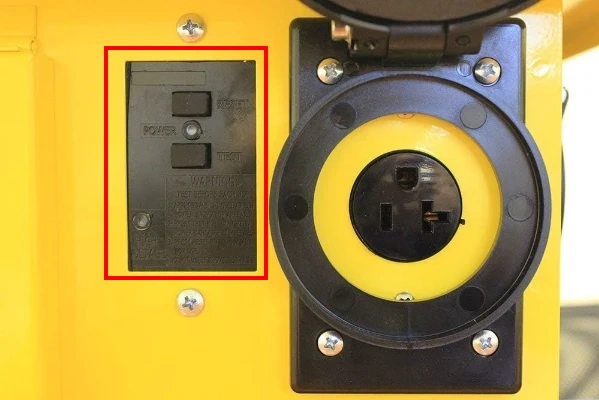
If the light is out and pressing the reset button does not turn it back on, proceed to #4.
-
Is the outlet overcurrent breaker tripped?
Each outlet has an overcurrent breaker. The breakers are located underneath a yellow hinged cover on one side of the spider box. Resetting the breaker should restore power as long as there is not an active short circuit present on the line.
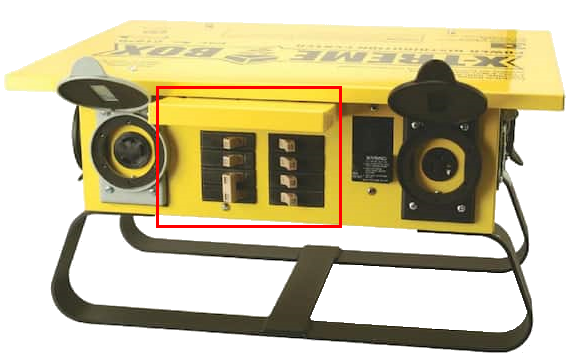
The most common cause of overcurrent trips are the usage of heat guns or other high-powered tools on too high of a setting. If this is the reason the outlet was tripped, start a dialogue with teams connected to that outlet to determine possible causes and mitigations in collaboration with the teams (e.g., coordinating high-power usage with pit power neighbors, discontinuing use of heat guns). If you are still having trouble, proceed to step #5. -
Check the overall power input status of the spider box. Are any GFCI LEDs lit?
If not, check the breakers on the distribution box. An overcurrent trip here will cause power loss to the entire spider box and any downstream ones daisy-chained off of it. If tripped, check all twist-lock cables going into and out of the spider boxes to make sure they are “locked” and secure. Move the twist-lock power cable feeding the spider boxes to another outlet on the distribution box and turn it on to restore power expediently. Work should begin to split power loads across multiple distribution box outlets. You may need to use a “clamp” amp meter to see if any sections of the pit are drawing substantially higher current than others, and make efforts to move those sections to their own outlet and breaker.